Showing posts with label Alla Prima. Show all posts

Tuesday, May 23, 2017

Paddington Portrait Project 1

Throughout history, the subjects in painted portraits have traditionally been the wealthy, the famous, and the powerful. It has always been elitist and remains so with the subjects painted for the Archibald Prize generally celebrities these days. People who are larger than life in more ways than one. I find each year I am enjoying the Archibald less and less.
To quote Robert Henri

"Salon pictures are a special and very overgrown and mongrel breed". 

 Or closer to home John McDonald speaks of  a good Archibald year as one in which he is not "gasping in disbelief'. (2012)

The portraits that move me the most are more intimate and dare I say more authentic. What Christopher Allen describes as  "a mutual connection between artist and sitter that makes a good portrait the crystallisation of a relationship" . 

Even when you consider the greatest of the Old Master portraitists, some of their most moving works are the more personal ones eg. Velasquez's portrait of his manservant, Hogarth's portraits of his servants.


Hogarth


I believe the Archibald has become more about who is painted than how well they are painted.

I have started a project of my own which is decidedly anti-Archibald. I want to paint ordinary people, men, women and children in a much more egalitarian way. I knew I would have to build up to this, get plenty of practice, not having done portraiture consistently for a couple of years.

I was also influenced by the conceptual work of Marina Abramovic with her piece "The Artist is Present", in which she sat in an art gallery and people sat and faced her for hours on end.


Marina Abramovic


I find this work and this idea intensely moving, so I decided early on that eye contact and a front on viewpoint was essential to achieve what I was after.

I like art that looks back. I imagine a whole wall of ordinary people looking back.


Robyn Bauer Studio


So this is it. I have launched the project. This is my studio wall with my progress so far.

I have set myself guidelines which may change or develop as time goes on. I am not sure where the project will lead. For now my guidelines are

* Everything is done from life in two or three sittings of about two hours each. Not exactly alla prima as I like the paint to fully dry so I can make adjustments boldly.
* Eye contact, front on
* Canvas size 40 x 40 cm prepared with a swish of raw umber. Heads generally about life sized. maybe a little larger.
* I will paint anyone who wants to be part of the project
* Ideally I would like a balance of different ages, personalities, ethnicities, gender but I don't have full control over this
* No photography

I have had to warn all my sitters that the very entertaining show "Anh's Brush with Fame" is exactly that "Entertainment" and that I would not be psychoanalyzing them, nor were they expected to keep on chatting. We saved the chat for the breaks. I also explained that while it appears that I am really staring at them I am actually making continual decisions about colour mixing, shapes, tone etc. It is they that have the opportunity to really look at me without interruption. I am too busy working to worry about what they may be thinking about me, although I've been told that I pull a lot of faces and I stand with my left hand on my hip!


Robyn Bauer with Viewfinder

And I use a viewfinder to make early decisions.


Here are some of the portraits in more or less chronological order.


 After I had exhausted the family members I had access to, I put a sign in the studio window asking for volunteers. I have had lots of generous strangers willing to give up fours hours or so.


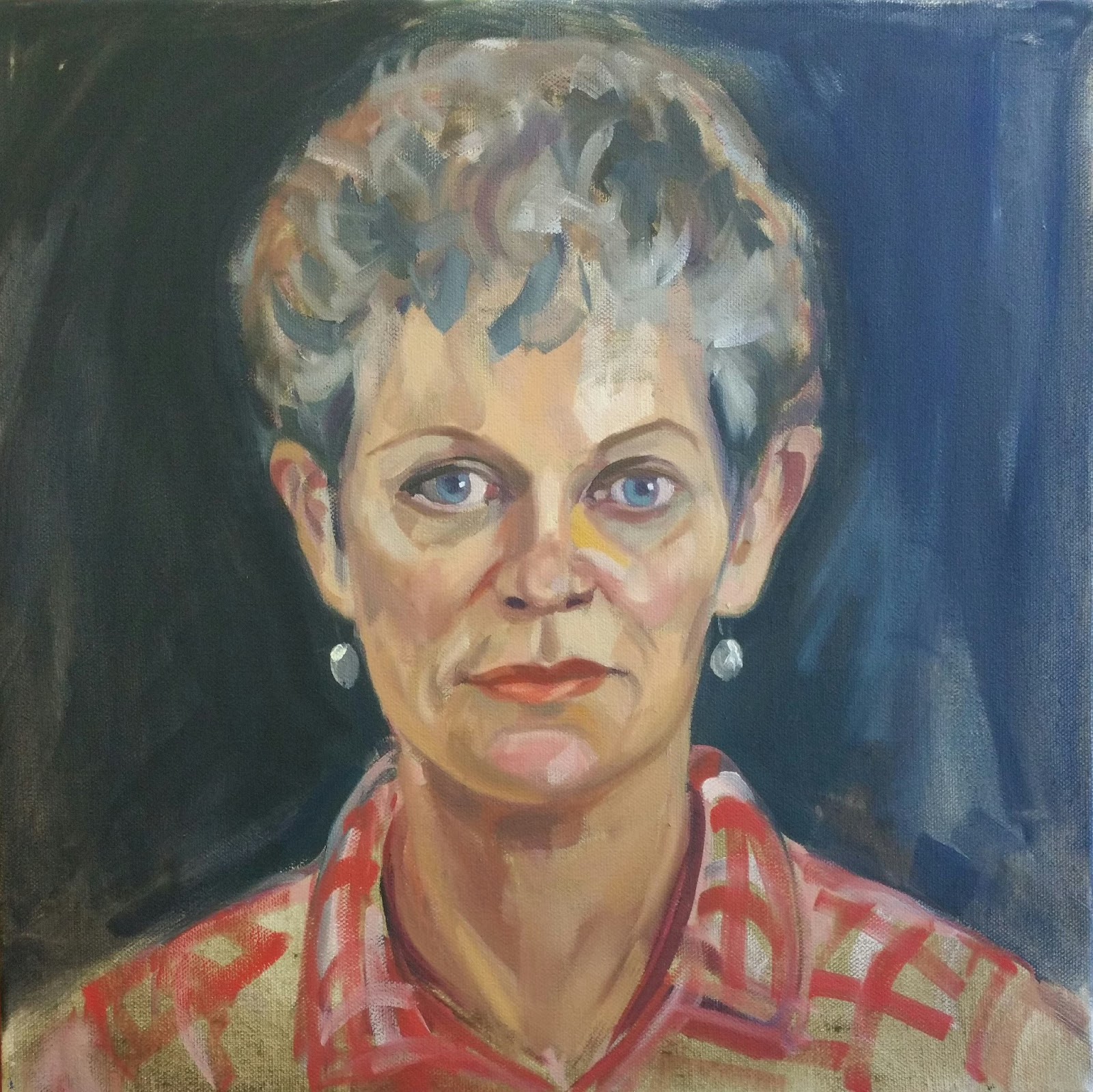


After I had done a few I had the courage to post a few of them on Social Media and I got a few more volunteers. Initially I wanted some link to Paddington, however tenuous but then I figured coming to my Paddington studio was link enough.


Husbands have modelled and then wives. I have made some good new friends. I know John Singer Sargent said that every time he painted a portrait he lost a friend. I guess his patrons were trying to call the shots considering the prices he was charging.


I am also very interested in how the experience of sitting feels for my models. Martin Gayford when sitting for Lucian Freud's "Man with a Blue Scarf" said his motive for sitting was "an assertion of my own existence". He said "The experience of posing seems somewhere between transcendental meditation and a visit to the barbers". 
"There is a rather pleasant feeling of concentrating and being alert but no need to do anything at all. 


The conversations had during the breaks have been lovely. One on one conversation always works best for me. I have learned about all sorts of things, including the geography of the surrounding landscape seen from my back deck. And several of my drawing boards have been expertly cut down for me by a master carpenter, seen above.


Keeping the backgrounds simple but accurate as far as my studio lighting goes, has also been an important factor. I have a black sheet up as a backdrop and it is magic for the contrast of beautiful white hair.


Basically my models are coming from pretty much everywhere. Friends, family, acquaintances, strangers, friends of friends, different aspects of my life, including fellow choir members.

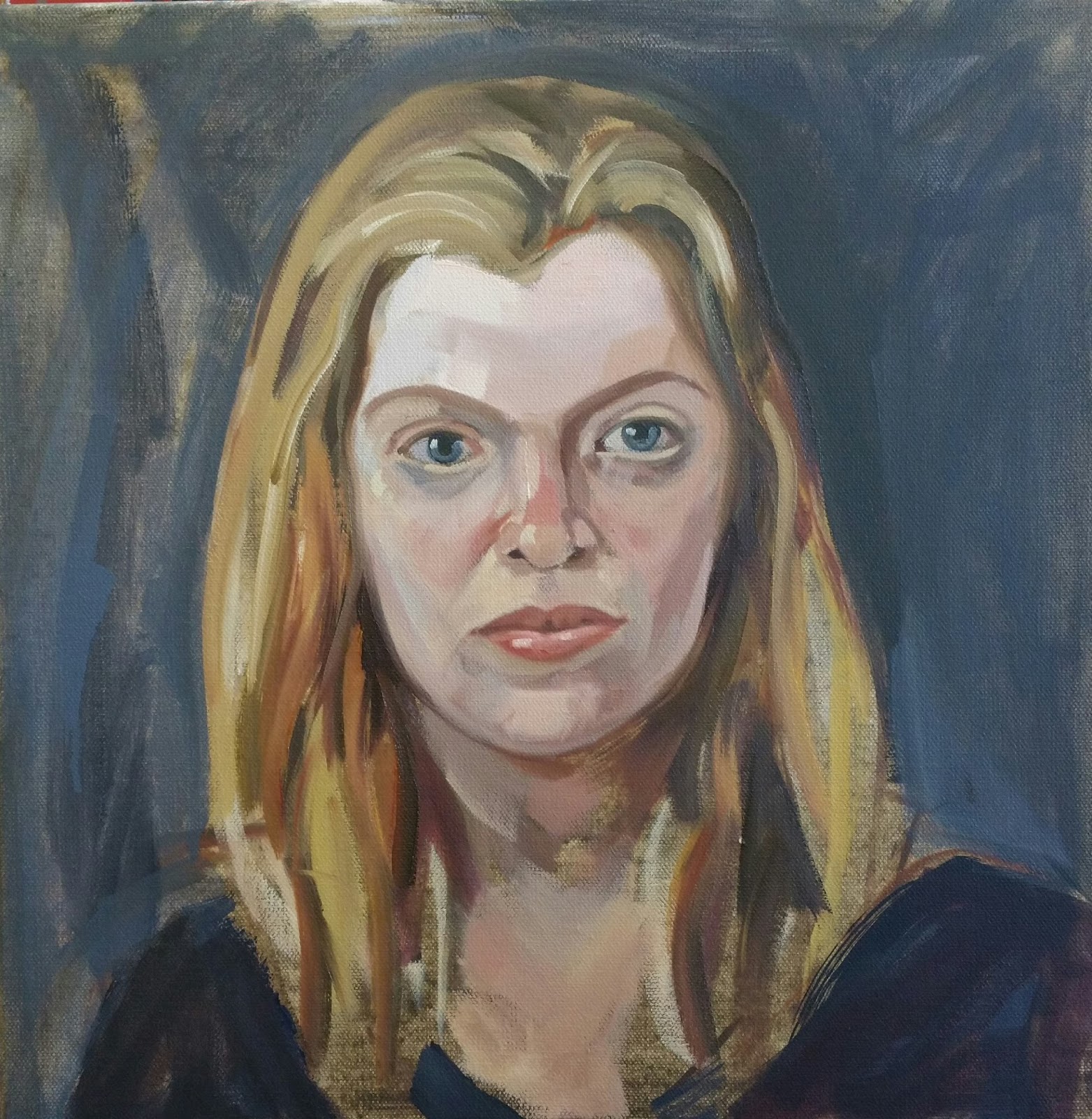


Some of them could do with another sitting but the sketchy finish suits others.


I want to have a balance of male and female but at this stage I am just painting whoever comes along.


Getting plenty of practice painting beards. They are all so amazingly different and I have added lead white to my palette for the first time.


And finally, if no-one comes along I have to resort to the family canines.

More to come.


Saturday, September 13, 2014

Male Portrait

Here is the next of my Friday morning portraits. It took about two hours of painting in a three hour session with lots of breaks for tea and cake.


We had an older male model for a change. As there are about eight people working in a group situation you don't really get to chose your position. It is more of case of everyone arrives and sets up in a semi-circle and then the model sits. You could sit either side to get a profile view but usually you just have to paint what is in front of you with little room to manoeuvre for a more fetching angle.

Our model Max had a great nose and I had almost a profile view of it with just a hint of the furthest eye. The portrait was all about the nose from the start against the dark background. There is a good connection colour-wise and design-wise with the ear. Ah, give me a good ear and I can paint it all morning!
I seem to have a habit of having to make the head bigger and bigger as I start. This meant that the back of Max's head got closer and closer to the edge. (Alas I didn't start with the dreaded thumbnail sketch!) I decided to turn this potential problem into an asset and used the head touching the edge to anchor the head slightly and give me the freedom to "open out" the front of the face and direct all attention there, at least initially.

Things seem to work better for me if I get stuck in quickly with what excites me and in this case it was the nose. The model even joked "Don't make my nose too big" and of course if this was a paid commission one might be slightly influenced by this expressed wish. I do so love working from a paid model with no pressure to please the client!

I worked from a seated position on a donkey easel and yes I did buy tubes of acrylic to take along instead of my big pots of colour. I had fun with the beard, - lots of blue and mauve hues and skin tone showing through. I can't remember the last time I painted a beard but I do remember it was also a white one and easily the lightest tone on the face apart from the highlights.

I did post this picture on facebook yesterday and two people immediately recognised the model and made comments, so I quickly removed it. I am fine about the painting being out there, but not sure what the model would think about all the comments and the ease with which anyone can make them. He would probably be fine but I will have to check.

I am really loving this weekly exercise in portraiture. I am still working hard every other day on my show for March 2015. These pieces are not ready to be revealed as yet.


Saturday, August 30, 2014

Friday Portraits

I am establishing a painting routine that is working well for me. Most of the week I work on my own in my studio and Friday mornings I go to Royal Queensland Art Society to work from the model. One week it is a nude figure the next it is a clothed figure suitable for portrait work. It is always just the one three-hour pose for the entire morning.

This is my painting from yesterday's session.


The model was nude and I was given the opportunity to "set" her pose so I chose a standing pose up on the plinth with her body facing towards me and her head angled away looking up. I was seated on a donkey easel with a lower viewpoint.

During the week I saw the amazing movie "In Search of Chopin"  and I was reminded of Delacroix's portrait of Chopin.


It is obviously just a quick head study not even progressing past the tonal block-in stage but the angle of the head really appeals. It has a lean not only sideways but also away from the viewer as if he is listening to music and concentrating. It is a fully Romantic image fitting in well with the feeling of that whole era of artists. painters, composers, musicians, and writers (George Sand) all being great mates and bouncing ideas off each other. Mutual respect was the order of the day. I have visited George Sand's house in Paris and it felt like a pilgrimage to the shrine of Romanticism. There is a great movie called "Impromptu" starring Hugh Grant as Chopin and Judy Davis as George Sand that I saw years ago that has stayed with me. In fact I used to dress in a men's style black suit  with tie there for a while in my youth!

To get back to my work, I had forgotten how much I enjoy working "alla prima". Obviously before the age of photography  everything was done from life (or from memory) but not necessarily as quickly as this sketch seems to have been done. You can't expect a model to hold such an obviously awkward angle for long. That is why I placed myself at the lower viewpoint.

The light was from above and to the left and I started boldly with yellow on the left of the face and purple on the right. I think the nailed the right side pretty early on and have just left it. The eye on the right I had to adjust several times and I do think it was because of model shifts after each break. I still have a plan of working with the "accidental" and the messy mark that is almost so wrong it is right, Almost!

Acrylic on card, big brushes throughout. Lots of the cardboard left to show through.


Tuesday, May 28, 2013

Robert Hannaford Workshop

About a week ago I was fortunate enough to attend a workshop by Australian artist Robert Hannaford. I have long admired his portrait work particularly his self portraits from unusual angles. I am certainly not alone in admiring his work as he one of the few artists who are loved by both artists and by the general public as his numerous "Peoples' Choice" awards gives testament.


This is Hannaford's amazing portrait "Bill" which won the 1990 Doug Moran Portrait Prize. I will return to it later but first some details about the workshop.

The class was for two days and Hannaford began with a brief overview of his thoughts and methods and a demonstration piece which he continued to work on over the two days. I took brief notes which I will reproduce here.

Robert Hannaford's Ideas

* Art is an "act of discovery"
* Don't have a plan
* Importance of a viewfinder to try different compositions and then the "That's the one I want" moment. As most of us didn't have this essential piece of equipment he proceed to make several out of paper for us.
* SHAPE  COLOUR  TONE
* Abstract pattern / Abstract shapes of the masses, and Light/Dark
* Objectivity
* Squint to see tone and open eyes (till they blur) to see colour,  Shift between these two.
* Don't fiddle
* Don't rush in
* Using viewfinder try vertical or horizontal composition/ different sizes of head/ inclusion of body etc.
* There is a psychological horizon in a portrait ( eye height if standing in front of it)
* Re-see every day, don't follow your drawing from the day before or even from the previous sitting before the break.

As far as his method goes, Hannaford started on a white canvas, blocked in using charcoal which he then wiped off just leaving traces. He also started with lots of paint which he wiped back. He did even put in some highlights early on ( not details, details were last) so I guess you could say his approach is an instinctive one.
Filbert brushes
He did a tonal block in, around the head etc.

* Only when you cover the whole canvas can you really see what's going on.

 And his main point which he repeated throughout the weekend

* DON'T EVER USE PHOTOS TO WORK FROM!!!!

He quoted Rembrandt as saying  "Nature is my master" and made the point that all the big leaps in art history have been made when artists returned to nature, i.e. Leonardo, the Impressionists etc. The Impressionists, painting plein air noticed that shadows were blue/purple and not the brown that Rubens painted.

He stressed the importance of composition from the start.

* Always rely on your own vision, not on your painting from yesterday.
* For his commissioned portraits he takes 6 to 7 days with a 3 hour sitting per day.

* Seeing is everything.
* Don't worry about technique, technique will look after  itself. Everything will look after itself.
* Spend 90% of your time looking, 10% painting
* Stand back /use mirror to view your progress.
* Don't copy other artists

He spoke about when he was young, taking his own work to his mentor Ivor Hele. He said Hele never said much he just looked, and Hannaford could then see his own mistakes as he felt he was seeing his own work through Hele's eyes.

Hannaford made an interesting point that we are on the verge of a Renaissance with our eyes.
* You can make unique discoveries.

I asked several questions about the painting of Bill (above) most notably about the dog and did he use a camera to capture the dog. He said he did not. (It is the artist's own dog.) There were over 100 sittings for the painting and the dog was there for about 50 of them. He says while other people train their dogs to fetch sticks,  he trains his dogs to pose.


                                Painting of Brett by Robyn Bauer

This is my effort after the two day sitting. I had a full-on profile which I did not choose as we drew easel positions out of a hat, but but I soon warmed to the possibilities (after using my viewfinder) and deciding to do landscape format which  I would not otherwise have done. The green curtain had been placed behind the sitter and framed the head very well for most of the painters but I ended up finding the book shelf very exciting (surprise surprise). I am sure I have never painted a bookshelf before.

Hannaford was very generous with his information and gave plenty of individual attention. There were some great painters there and some great paintings by the end of the weekend.

Wednesday, January 9, 2013

Portrait of Tom in Progress

I have been working on this portrait of Tom for the past week (only one short sitting per day as he is very busy) and I have taken a few progress shots. It is quite illuminating for me to look back at where I have been. I am also much more aware of some of my working habits, both good and bad. The technique is totally "alla prima" painted from life. Each sitting was about 30-40 minutes. Oil on canvas.


I toned the canvas with Raw Umber a few days before and let it dry as I hate working on a wet surface. I never start on a white canvas as I like to have control of my lightest tones early on.


When I compare these first two images it is quite obvious that I tend to work "all over" . I am not sure if this is a good thing or not. I know there are so many differing ways of working. I can't fathom the method some artists have of totally completing an area before moving on to the next. I know Lucien Freud did this. Maybe I should try it sometime just as an exercise.


Getting a bit more 3D modelling into the face now. Going into the dark areas to identify colour, which is a bit exaggerated at this stage. Correcting the ear. Cool lights.


Indicating the shirt. Getting the modelling of the mouth angle a bit more accurate.


Warming up my shadows. As the spotlight is a cool light I am following the basic principle of cool lights and warm shadows but it is almost an unconscious thing now. Observation is the real guide.


Put more of a focus on the hint of "Rembrandt triangle" on the cheek on the left. Made the nostrils more accurate and firmed up the ear. More highlights on the hair. Also I have hinted at a small smile as I had made Tom look a bit grim. He did have trouble staying awake so I made a pot of tea.

Still not quite finished. Now that I can see it here on the screen there are several things screaming at me to be fixed. Amazing how seeing the image at a different scale smartens up your eye. 


Thursday, December 27, 2012

A Word or Two about Colour

Colour and an understanding of it are vitally important in my work. My thoughts about it have developed the more I paint and I thought I'd share some of my discoveries in this post.

I read recently (unfortunately I forget where exactly but it was either in Simon Schama or Betty Churcher or a book on Courbet)
"It is only what you realise for yourself (or learn the hard way) that has any value as an artist"

I know that I have always been doing it the hard way, teaching myself what paint does, what acrylic will do, what oil will do, what tone will do and what colour will do. The things that I have discovered for myself are what make my work truly mine.

John Worth (Australian artist) related an anecdote to me about Rembrandt. Apparently Rembrandt told his pupils
"Use the richest blackest black you can grind and a pure white ... and other colours only sparingly"
I am finally learning that to have one colour sing it has to be surrounded by subtlety. The mixed tertiaries (or layers) can have it all. Just exaggerate one tiny section of already there colour.

One never stops learning with regard to colour and about six months ago I completed the following colour charts.


I can't begin to express how much the process of doing these eleven charts taught me. I acknowledge that it was my friend artist Terry Bouton who urged me to complete them. (It takes weeks to do them properly.) This method of colour mixing is discussed in the book "Alla Prima - Everything I Know about Painting" by American artist and teacher Richard Schmid. I have since come to understand that Schmid enjoys something of a cult following in the United States. He was the teacher and mentor of the Chicago group which includes Clayton Beck.

One of the most enlightening things about doing the charts is the importance of black just as Rembrandt advised.

I have heard so many artists proudly proclaim that they don't even own a black. This of course comes from the Impressionist idea of various colours in the shadows rather than blacks or greys, but to leave black out is a severe handicap.

The colours in each chart are from L to R

Cadmium Lemon
Cadmium Yellow Deep
Yellow Ochre Pale
Cadmium Red
Terra Rosa (which is similar to the pigment called Light Red)
Tranparent Red Oxide
Alizarin Crimson
Ivory Black
Viridian
Cobalt Blue
Ultramarine Blue

Eleven Colours in all. There is a chart for each colour as the dominant hue mixed with differing amounts of the others plus white.


This is the chart for Viridian which was absent from my portrait palette before but is now a staple for mixing with the others.


This is my chart for Terra Rosa, one of my favourites. The range of hues for portraits is very beautiful and varied.

I have these charts on the wall near to where I am working and I consult them frequently.

There is another totally separate point I wanted to make about colour and it is that of
Colour Symbolism.

This is something I have worked with for years but it is enhanced by the juxtaposition with the carefully mixed tones already discussed.

These meanings come into play in the use of a focus colour or even a series of highlights. They do sound a bit New Age-ish but I don't see that detracting from the ideas.

Cobalt - connects to a higher purpose.
Turquoise - deepens ecstasy
Yellow - clarifies
Orange - inspires fusion
Saffron - kindles love
Magenta - sparks higher mental. emotional and spiritual processes
Purple - reinforces supremacy, links to an elevated state
Green - explores expansion and growth, tranquility
Lime - awakens the spirit
Blue - expresses self esteem and mystery
Powder Blue - invites contemplation
Light Green - evoks wistfulness and relief
Gold - expresses abundance
Lavender - freedom from cravings
Red - ignites, stimulates
Terracotta - strengthens security
Pink - Unconditional love and nurturing

I have distilled this list with the help of many internet searches. It is a lot of fun as well as being thought provoking, especially when you consider what colours one may choose to wear or what colour a portrait subject may be wearing, backgrounds, details, inclusion of objects  etc.

Over the years I have noticed my own palette becoming more refined, less bold, more discerning and subsequently a lot more versatile. I do believe though that there is no substitute for instinct and the instinctive use of colour. Even if colour is used instinctively though, knowledge of its meanings provides another level to be appeciated.